
Eighty-five years ago today, the American Institute of the History of Pharmacy was founded at the University of Wisconsin. The institution was largely the product of a collaboration between Edward Kremers, a professor of pharmacy at the University of Wisconsin, Madison, and George Urdang, a German pharmacist and historian.

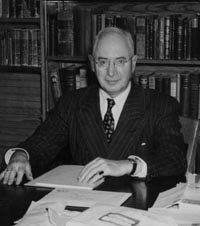
First Image: Edward Kremers in front of an exhibit of historical pharmacopoeias put together by the UW Department of Pharmacy at the annual American Medical Association convention in Milwaukee in June 1933. Second Image: George Urdang sitting at his desk in the School of Pharmacy.
Kremers was born to a family of German immigrants in Milwaukee. After obtaining his bachelor’s degree in Philadelphia and Wisconsin, Kremers moved to Germany in 1888 to pursue a postgraduate at the University of Bonn and the University of Gottingen. He would study under and alongside some of the most famous scientists of the nineteenth century, including Otto Wallach, August Kekulé, and Walther Nernst. In 1890 Kremers would return to the United States with what his future associate Urdang described as “the holy zeal of a missionary”. Upon his return Kremers became an instructor of pharmacy and quickly ascended to become the director of the program in 1892.
When Kremers became the director of the pharmacy program, pharmaceutical education was quite different than it is in the modern day. For much of the nineteenth century, pharmacy was viewed as a trade rather than a profession. As a result, pharmaceutical programs generally emphasized apprenticeship rather than theoretical education. However, this was changing at the end of the nineteenth century as more universities would turn towards a more scientifically grounded curriculum. Partially inspired by the rigorous and well-rounded education he received in Germany, Kremers would advocate for the university’s pharmacy curriculum to include a full four-year program which included courses in the humanities. This contention would often put him at odds with the pharmaceutical establishment, who criticized his proposals as unrealistic. In the coming decades, however, this form of pharmaceutical education would become the standard.

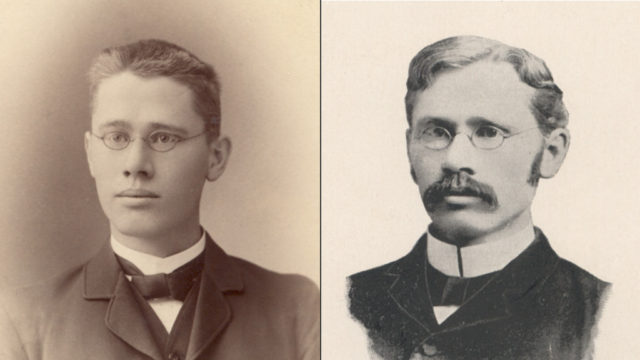
First Image: George Urdang in the top right at the 10th Anniversary Conference. Second Image: Edward Kremers in 1886, the year he earned his undergraduate degree from the UW Department of Pharmacy (left), and Kremers circa 1895, as a young professor in the Department of Pharmacy (right).
In the early twentieth century, Kremers would develop courses on the history of pharmacy, forming the antecedent of the AIHP. Kremers took an active interest in history and amassed an enormous collection of artifacts over the years, most of which now find their home in the AIHP’s archives. In the late 1930s, Kremers would find a key ally in his mission to preserve the history of pharmacy in George Urdang. In Germany, Urdang made his career both as a pharmacist and as a scholar of pharmaceutical history, offering prominent contributions to journals dedicated to medical history. This brought him to Kremers’ attention, and the two started correspondence by mail in 1921. In 1938, Urdang, who was Jewish, fled to New York to avoid persecution under the Nazi regime. During this time Urdang continued to correspond with Kremers, finalizing their ideas for the creation of an institution dedicated to the history of pharmacy.
In 1939, Urdang moved to Madison, Wisconsin to collaborate with Kremers. Urdang was in a tenuous position: he was adjusting to life in the United States, mired in poverty, and was unable to secure a full-time position at the University of Wisconsin. To make matters worse, Kremers was in declining health. Nevertheless, Urdang and Kremers collaborated on the first edition of History of Pharmacy, which would be published in 1940. The book was well received and has been revised three times, with the latest edition being released in 1976. The AIHP was founded one year after the publication of History of Pharmacy in 1941, and Kremers would pass away shortly afterwards. The founding of the institute gave Urdang a steady position at the University of Wisconsin, and he would continue to work there until his retirement in 1951.
The efforts of Kremers and Urdang, along with countless other scholars, researchers, and members throughout the past 85 years, have provided a home for the history of pharmacy. As we celebrate the anniversary of our founding, we would like to thank everyone who has contributed to the success of the AIHP.
This Dose of History is brought to you by AIHP Intern Leo Ryan.
Bibliography:
Bond, Gregory. “The 1892 Controversy That Transformed Pharmacy Education.” University of Wisconsin School of Pharmacy, June 1, 2018. https://pharmacy.wisc.edu/2018/06/01/kremers-innovated-pharmacy-at-uw-madison/.
Buckner, Carl K., Kenneth A. Connors, John Parascandola, and George Zografi eds. The University of Wisconsin, School of Pharmacy: Its First Century. University of Wisconsin Press, 1997.
Sonnedecker, Glenn. “George Urdang in Madison: As I Remember Him.” Pharmacy in History 43 no. 2-3 (2001): 59-65. https://www.jstor.org/stable/41112048?seq=4.Urdang, George. “Edward Kremers (1865-1941): Reformer of American Pharmaceutical Education.” Pharmacy in History 58 no. 1-2 (2016): 41-54. https://www.jstor.org/stable/10.26506/pharmhist.58.1-2.0041.