
The early twentieth century was a time of rapid change in pharmaceutical practice. Prohibitionary laws, instituted for the first time on the federal level, would dramatically shift the relationships between pharmacists, the drugs they sold, and consumers. Central to the onset of these changes was the problem of opium addiction, which was becoming an increasingly salient issue in the medical press. By the late nineteenth century, several pharmaceutical trade magazines and medical newspapers were writing–with varying degrees of sensationalism–about the growing masses of opium ‘habitués,’ and calls to legislate the sale and use of the compound grew.
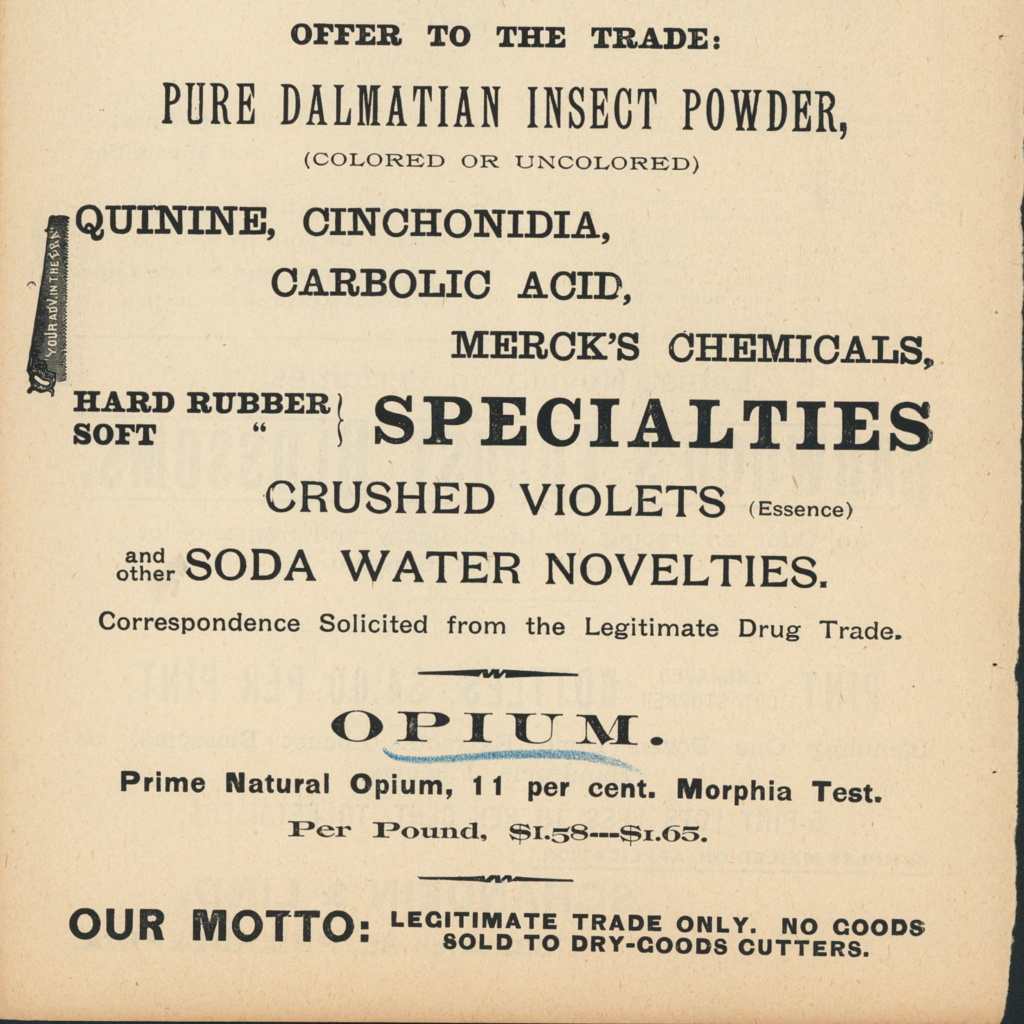
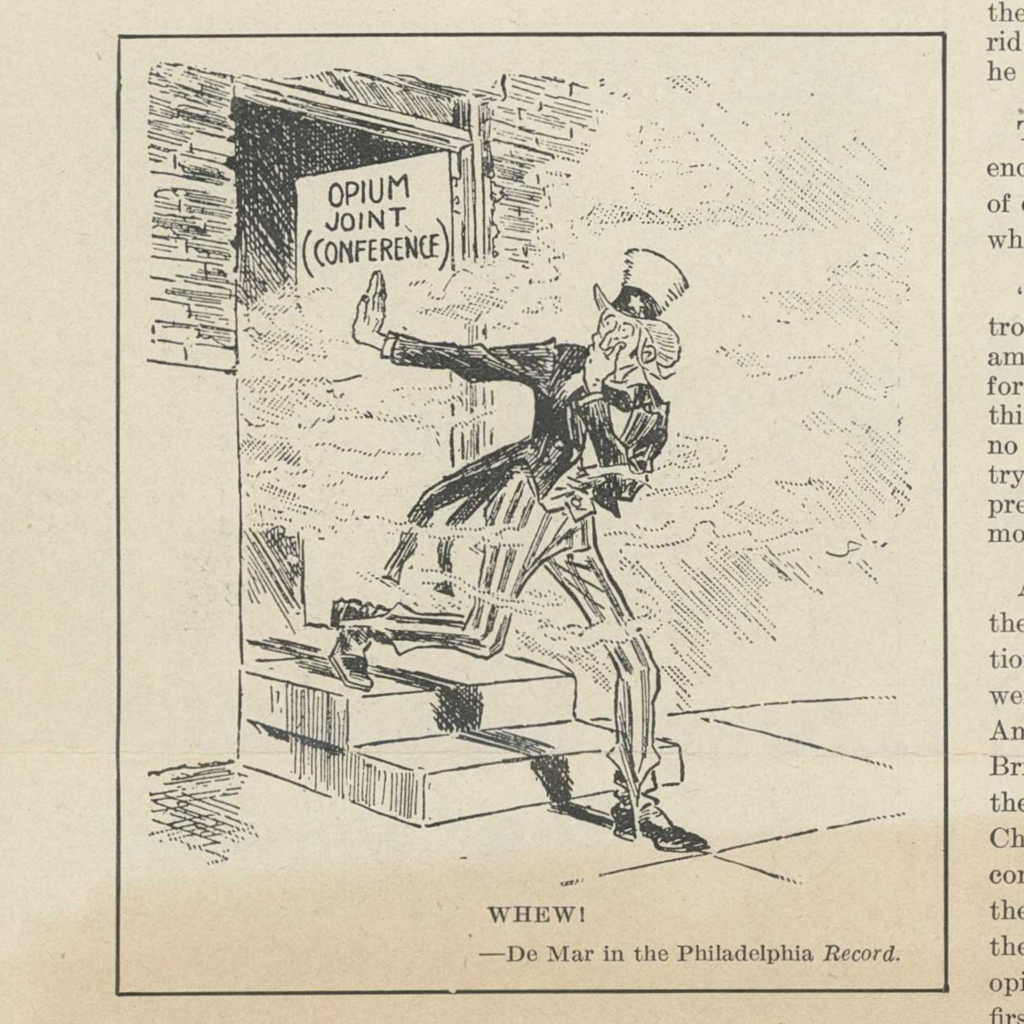
By the 1910s, these concerns began to translate into legislation. There was no shortage of drug laws on the state and local levels, but the efficacy of these laws was often called into question. “No matter how stringent local laws may be,” wrote one journalist for The Druggist’s Circular in 1909, “if the drugs are allowed on sale without restriction in any of the States, they are bound to find their way into the forbidden territory.” Concurrently, several developments in international and domestic politics made the prospect of federal legislation more appealing to citizens and lawmakers. In an international context, many publications framed opium use as a foreign threat which was especially common among East Asian people. The United States’ occupation of the Philippines in 1898 therefore positioned them as the foremost anti-opium crusaders on the geopolitical stage, and American efforts spurred on international conferences aimed at curbing opium use in 1909, 1912, and 1925. Meanwhile, domestic political ideologies such as the Progressive and Temperance movements sought to alter the role of the federal government and its relationship with public health. Legislation such as the Opium Exclusion Act in 1909 and the Harrison Act in 1914 granted the federal government greater power in regulating the importation, distribution, and use of opium and other psychoactive substances.
Pharmacists themselves would also emerge as prominent advocates for regulation of the drug trade. After the passage of the Harrison Act, a 1916 article published in the Journal of the American Pharmaceutical Association claimed pharmacy has “deliberately sought this legislation and has cheerfully accepted the burdens and losses which it imposes for the sake of the general public good.” Despite the losses as a result of the taxation of opium, curbing drug addiction–perceived by many to be an issue which started by the reckless dispensation of opium by druggists–would be good press for pharmacists. In a wider context, this was happening as pharmacy was increasingly resembling a professional practice which required university education and years of training rather than a trade. This was a transformation which many pharmacists, especially those with the resources for political activism, advocated for, and the regulation of drug use would contribute to that process considerably.
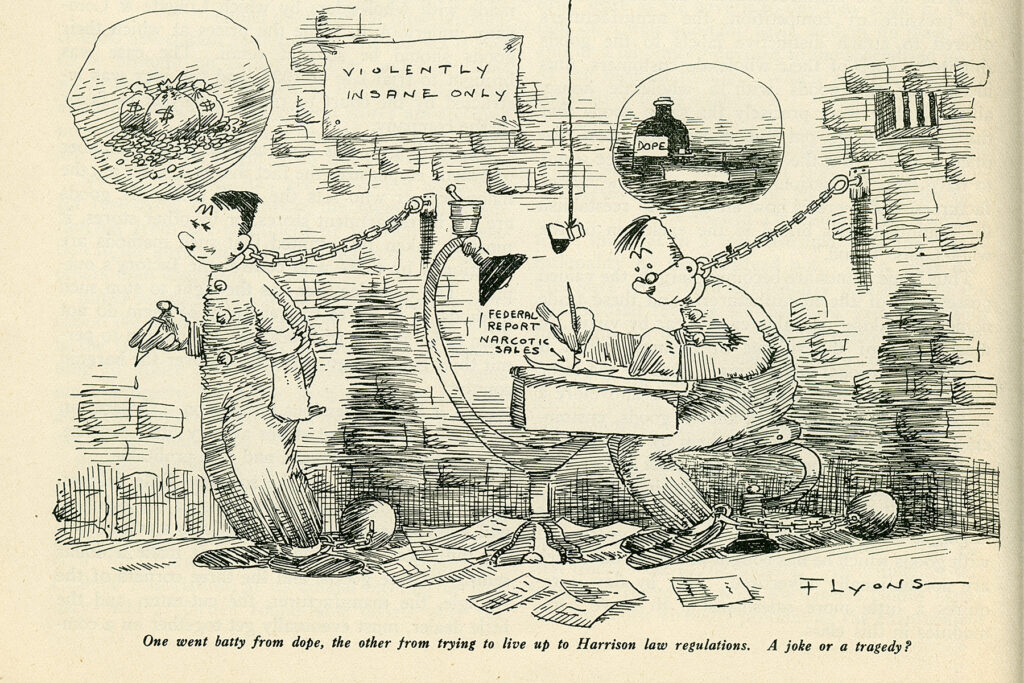
Of course, regulation, especially in the form of taxation, was also met with some bottom-up resistance. Many pharmacists would criticize the Harrison Act in particular as a nuisance, as it required all sales of opium to be logged, tracked, and taxed, increasing the workload of the pharmacist. Many less scrupulous pharmacists would attempt to skirt around the law entirely. An article in The Druggist’s Circular published in 1916 reports one drugstore in Virginia which prescribed “excessive amounts of narcotic drugs, prescriptions calling for a pound of opium, 1,000 quarter-grain morphine tablets, one ounce of cocaine, and one ounce of heroine” before authorities began investigating the operation. These exceptions, however, seemed to be exceedingly rare. An article published in the same journal in the same year notes “considerably less than one-half of one per cent” of pharmacists were charged with violating the Harrison Act.
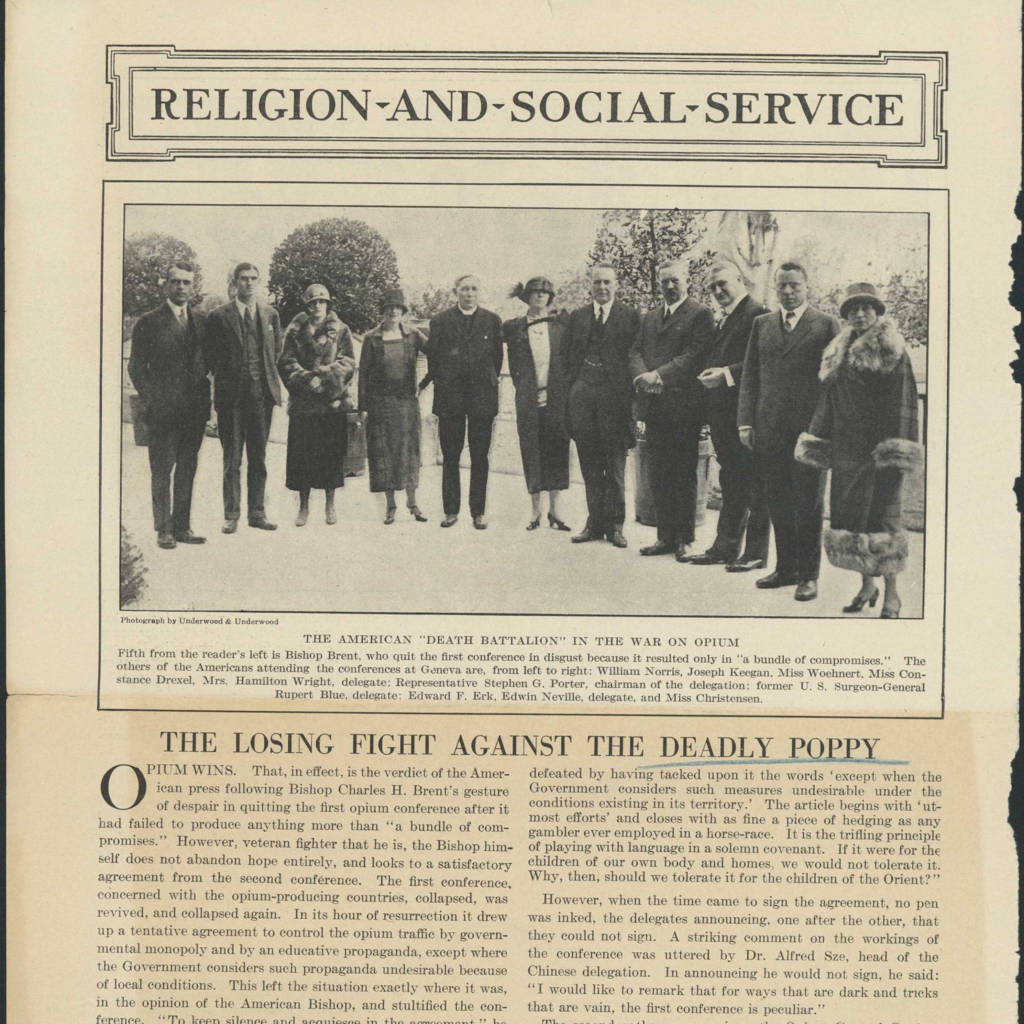
Since most pharmacies were cooperative with the Harrison Act, people who continued to use opiates would have to resort to illegal means of obtaining it. This would result in the growth of a black market for opiates, and by the 1930s it was large enough to warrant attention from the government. One report on drug addiction written in 1938 by Thomas Parran, the Surgeon General at the time, shows how the problem of drug addiction was framed. (The report is on drug addiction in general, but Parran highlights opium as “the most important addicting drug” and claimed opium addicts were most common in treatment facilities.) Commenting on the shortcomings of the government’s response to drug addiction, Parran says:
“From doing nothing about the narcotic problem we started in a sudden burst of enthusiasm to clean up the situation without proper regard for human values and without considering the suffering and distress entailed in a rigid enforcement of the [Harrison] law as it stood. The law, in effect, made criminals out of persons who were guilty only of suffering from the effects of a weakness that they could not control.”
Although Parran characterizes drug addiction as a failure of character, describing it as a ‘weakness,’ the advocacy for medicalization reflects a more scientific and less moralized view of the issue. One other textbook book on pharmacology from 1942 agrees that the drug addict “should be placed in an institution,” representing a view of drug addiction that is more sympathetic yet still considers the restraint of the addict’s civil rights to be legitimate.
To address the issue of drug addiction, the federal government established an experimental rehab center in Kentucky in the 1930s. Within this facility, nicknamed ‘Narco,’ the medical and criminal conception of the drug addict coexisted: some inmates were there voluntarily and could leave at any time, and some were sent there by law enforcement and had to serve a full sentence. Although Narco was innovative in its approach to drug addiction by emphasizing rehabilitation rather than punishment, it was not immediately effective. One pharmacological textbook written in 1954 by pharmacists John C. Krantz and C. Jelleff Carr reports that with regards to the facility’s treatment of opium addicts, “success has not been remarkable. From 1936 to 1941, 4700 addicts dismissed from the hospitals have been reviewed. Only 25 per cent remained abstinent.” Krantz and Carr go on to give a dismal view on the prospects of overcoming opium addiction, remarking simply: “You cannot win against it.” The facility in Kentucky was transformed into a hospital for federal prisoners in the 1970s, around the time that the “War on Drugs” was declared.
Though the science and cultural perception of opiate addiction have changed considerably since the 1930s, questions which first arose during this time period are still being debated: What rights do governmental and medical institutions have when intervening in drug addiction? How should we, as a society, view people addicted to drugs? What methods of treatment are most humane and effective? As evidenced by the fact that our society has grappled with these questions for more than a century, these are not easy questions to answer, yet they are increasingly relevant. Opiate addiction has seen an upsurge in the past 30 years, with over 100,000 deaths from an opioid overdose annually. Understanding opium’s history in American society may provide lessons which will inform how we address this crisis, as well as a starting point to assess the relevance of opiates to our culture.
This Dose of History is brought to you by AIHP Intern Leo Ryan.
Bibliography
Secondary sources:
Barop, Helena. “Building the «Opium Evil» Consensus – The International Opium Commission of Shanghai.” Journal of Modern European History / Zeitschrift Für Moderne Europäische Geschichte / Revue d’histoire Européenne Contemporaine 13, no. 1 (2015): 115–37. https://www.jstor.org/stable/26266168.
Ward, Eva. “Opiates, Labor, and the US Colonial Project in the Philippines, 1898-1908.” History of Pharmacy and Pharmaceuticals 63 no. 2 (2021): 223-246.
Nancy Campbell, J. D. Olsen, and Luke Walden. The Narcotic Farm: The Rise and Fall of America’s First Prison for Drug Addicts. University Press of Kentucky, 2008.
Primary sources (accessed through the AIHP’s Edward Kremers archive):
“Curtailing the World’s Opium Traffic.” The Druggist’s Circular, November, 1909. 575.
J. H. Beal. “The Community of Interest of the Drug Trades in Food and Drug Legislation.” Journal of the American Pharmaceutical Association, February, 1916. 175.
“Excessive Quantities in Narcotic Prescriptions.” The Druggist’s Circular, October, 1916. 623.
“Four Months of the Harrison Law.” The Druggist’s Circular, February, 1916. 65.
Thomas Parran. “The Problem of Drug Addiction.” U.S. Treasury Department. Reprint from Public Health Reports 53 no. 50 (December 16, 1938): 1293-2197.
Ramon Davison. Synopsis of Materia Medica, Toxicology, and Pharmacology. C.V. Mosby Company, 1942. 272.
John C. Krantz and C. Jelleff Carr. The Pharmacologic Principles of Medical Practice. Williams & Wilkins Company, 1954. 531-532.