
The earliest known form of inoculation, called insufflation, dates back to the sixteenth century. It was typically carried out by blowing powdered smallpox scabs up the nose of the patient. In the modern day, we have considerably less gruesome methods of inoculation due in part to the science of bacteriology, which came into its own in the late nineteenth century. The development of germ theory, the invention of pasteurization, and the isolation of certain viruses had won the field international respect and made it a promising economic investment for academic and governmental entities.
From 1880 to 1930 vaccines were developed to prevent rabies, typhoid, cholera, tuberculosis, diphtheria, and other diseases which had plagued humanity for thousands of years. By the early twentieth century, it was fairly common for drugstores to carry vaccines. One 1901 article in The Pharmaceutical Era notes that “vaccine virus is found far more frequently among the stocks of pharmacists at the present time than several years ago” due in part to a resurgence of smallpox in the late nineteenth century, going on to state that “professional men as well as all intelligent and observant laymen realize that immunity from the scourge [of smallpox] can only be secured by periodical vaccination.”





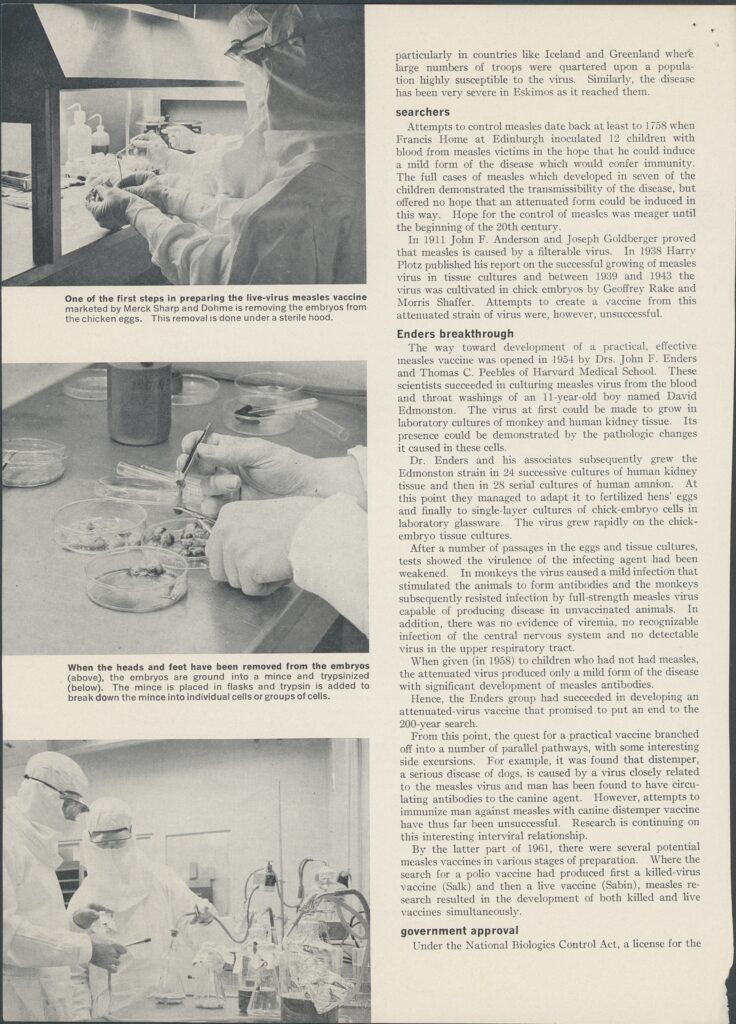
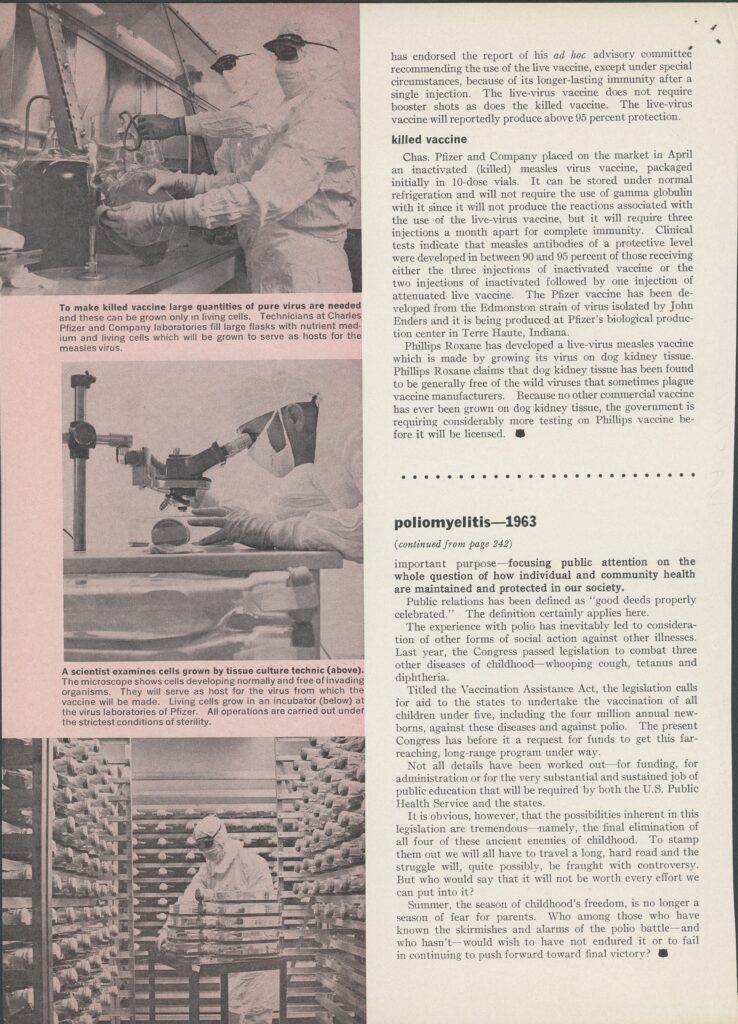
Despite its prominence and high virality, a measles vaccine would not be made widely available until 1963. One breakthrough came when John Enders, Thomas Wellers, and Frederick Roberts discovered a way to culture various viruses in a sterile environment in the 1950s. This would allow measles to be cultivated in vitro, that is, in a petri dish. This development made live-virus vaccines viable by cultivating a weakened strain of the virus independent of a live host. Compared to inactivated-virus vaccines, live-virus vaccines typically require less doses, making them more viable both practically and financially.


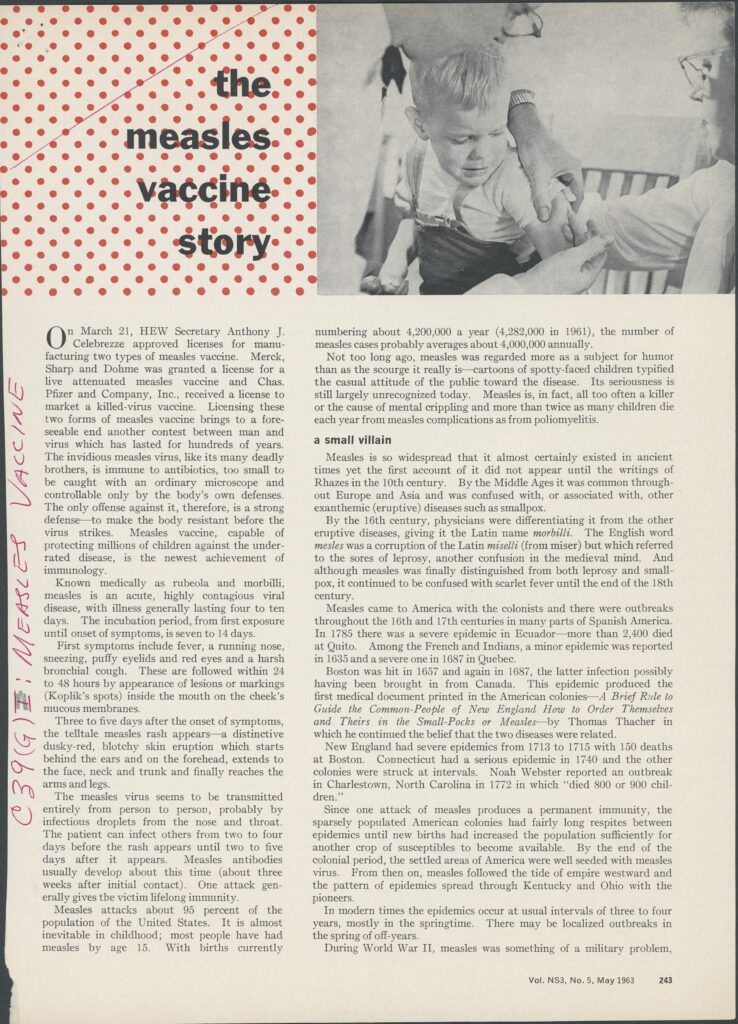
In addition to the scientific constraints, in American culture measles was generally seen as a minor affliction. “Not too long ago,” reads one health science magazine published in 1963, “measles was regarded more as a subject for humor than as the scourge it really is.” Though this view may have been propagated out of necessity as there was no vaccine available for most of human history and measles was incredibly common prior to 1963, it downplays the dangers of the virus significantly. Measles can pose significant danger to people who are malnourished or immunocompromised, and is especially dangerous to young children. Additionally, complications from the virus can lead to long-term health problems, even in healthy individuals.
Due to governmental support for vaccine initiatives and a culture which strongly encouraged vaccination, the prevalence of measles in the United States hit an all-time low around 2000 and was deemed eradicated. However, the perception of measles as a minor, relatively harmless virus has persisted to some extent to the modern day. Despite the fact that inoculation has been a part of human society for centuries, in recent years vaccination rates have fallen significantly due to discredited studies linking vaccines to autism. In the late 2010s, this resulted in a resurgence of the measles virus. As of February, there have been over 900 cases of measles reported in the United States since the beginning of 2026.
This Dose of History brought to you by AIHP Intern Leo Ryan.
Bibliography:
Boylston, Arthur. “The Origins of Innoculation.” Journal of the Royal Society of Medicine 105, no. 7 (2012): 309-313. https://pmc.ncbi.nlm.nih.gov/articles/PMC3407399/.
“Measles Cases and Outbreaks.” Centers for Disease Control and Prevention. Last revised February 20, 2026. https://www.cdc.gov/measles/data-research/index.html. https://pmc.ncbi.nlm.nih.gov/articles/PMC4151719/.
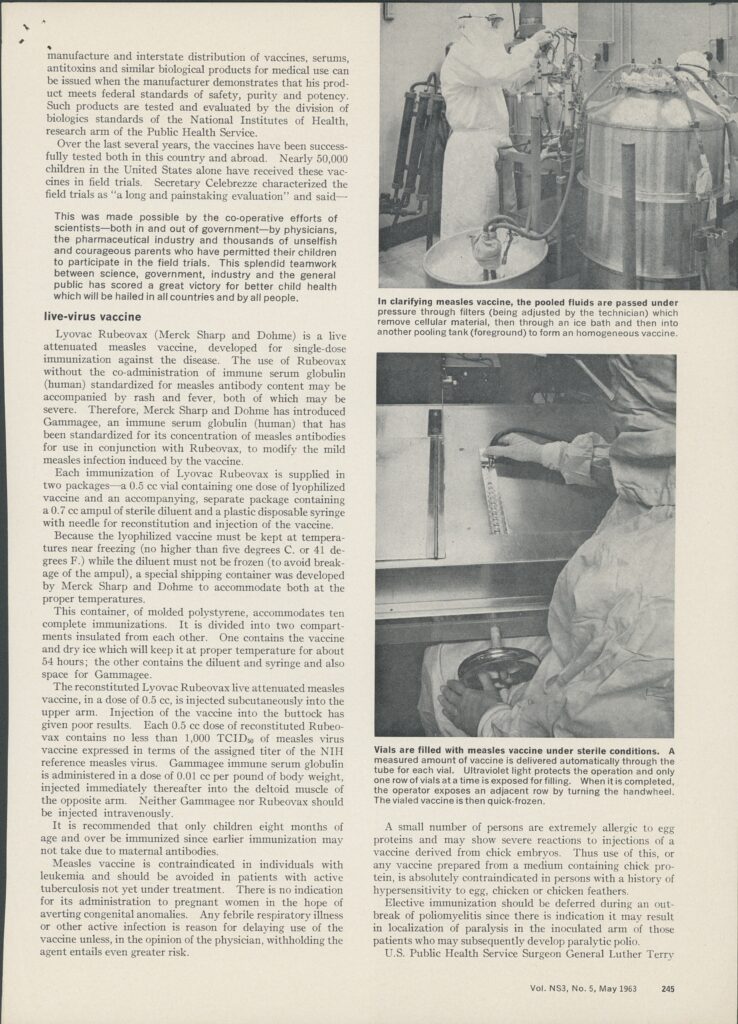
“The Measles Vaccine Story.” Article cut out, magazine name and author unknown. May, 1963. Accessed through the AIHP Edward Kremers Research Library and Archives.
Opal, Steven M. “A Brief History of Microbiology and Immunology” in Artenstein, Andrew W. eds. Vaccines: A Biography. Springer New York, 2009. 31-56.
Parums, Dinah V. “A Review of the Resurgence of Measles, a Vaccine-Preventable Disease, as Current Concerns Contrast with Past Hopes for Measles Elimination.” Medical Science Monitor 13 no. 30 (March, 2024). https://pmc.ncbi.nlm.nih.gov/articles/PMC10946219/.
Plotkin, Stanley. “History of vaccination.” Proceedings of the National Academy of Sciences (USA) 111 no. 34 (2014): 12283–12287. “Vaccine Virus.” The Pharmaceutical Era, March 28, 1901. 332. Accessed through the AIHP Edward Kremers Research Library and Archives.