
In 1928, The Opium Problem, authored by Charles Terry and Mildred Pellens, was published by the New York City Bureau of Hygiene. The book contains testimonies from dozens of medical professionals from the 1870s to the 1920s and numbers over 1000 pages, making it one of the most comprehensive studies on drug use of its day and a landmark text in the development of a theory of addiction. Long before the publication of The Opium Problem, however, concerns were increasing among the general public about opium use. The latter half of the nineteenth century marked a steady increase in both medical and recreational opium use, and although it is impossible to estimate the actual number of opium users with any certainty the written records of this period speak to a growing concern for the issue in the public consciousness.
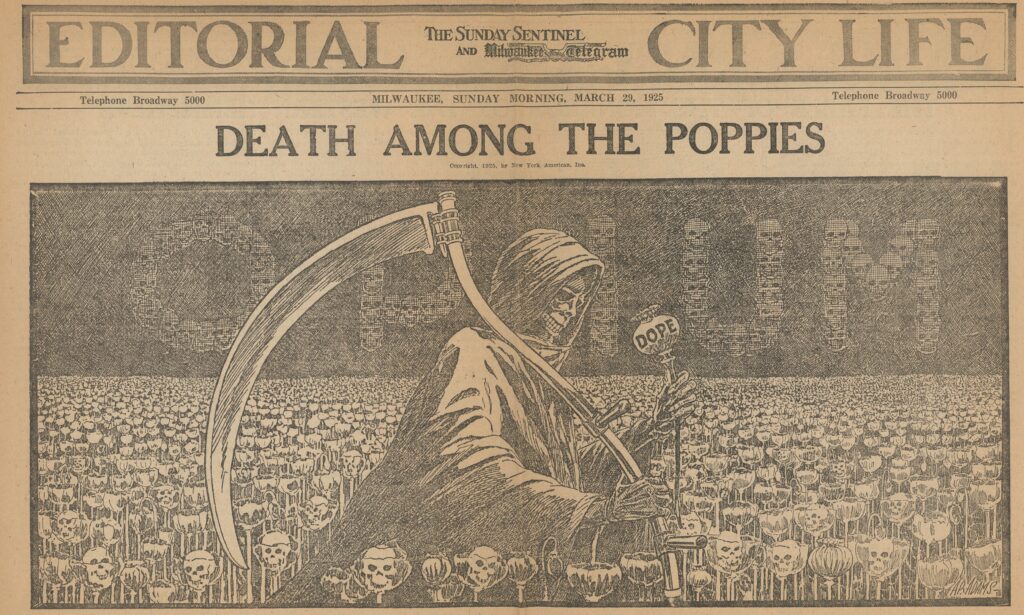
Overwhelmingly, American writers posed the opium problem in racial terms. “It is true that opium is not likely to become popular among an active and industrious race like the Anglo-Saxon,” writes the pharmacologist Alfred Stillé in 1874, “but men of active and warm imagination, as the Orientals generally are, will choose the stimulant which multiplies and gives a livelier coloring to the ideas.” In 1890, an article published in The Pharmaceutical Era regarding opium smuggling in the United States presents a similar sentiment: “Opium smoking is fortunately confined to the Celestials [meaning Chinese people] themselves, and is not ever likely to become a habit of the Americans.” Finally, an article in The Pharmaceutical Record published in 1891 asserts that “the Chinese are responsible for the introduction of the custom [of opium-smoking] into the United States.”
As these quotes indicate, opium use, and specifically opium-smoking, was largely associated with Chinese immigrant communities. Since the Chinese population was regarded with disgust by many of the White population, there are no statistics on the actual rates of opium use among the immigrant population. However, one account published around 1880 in The Druggist describes one opium parlor in Chicago which was, to his surprise, “patronized by American smokers.” Indeed, opium had been used in America on a considerable scale since the Civil War, so this association was certainly motivated by racial prejudice. Anxieties over Chinese labor supplanting White labor, rigid segregation between Chinese and White communities, and the prevalence of pseudoscientific and eugenicist theories of racial science would make the late nineteenth century a time of overwhelming discrimination against the Chinese-American population. As such, drug addiction, which many associated with moral degradation or considered a moral failure in and of itself, was often associated with a population deemed morally inferior by White society.
This discrimination, however, was coupled with a cautious fascination. For many Americans, opium seemed to embody all the dangers and mysteries of ‘the Orient.’ White tourists would tour Chinatowns in cities like San Francisco, sometimes explicitly seeking out opium dens. For those not willing to take the trek, the opium den was a frequent subject of photography and, as the medium came into development, film. In 1894, a company founded by Thomas Edison produced Chinese Opium Den, a thirty-second film which depicts a purportedly authentic opium den, though it was quite obviously filmed in a studio. Opium would continue to figure quite prominently in the films of the early twentieth century until censorship began to take place on a wider scale.
In contrast to Chinese opium users, who were believed to become addicts due to cultural customs or their racial characteristics, the medical press generally blamed systematic or socioeconomic factors when writing about White opium users. Most sources around the 1880s and 1890s claim that opium addicts obtained the drug through legal avenues and were often introduced to the substance by a doctor. In 1879, a report on opium use in Michigan found that “the sales of sulphate of morphia by [one drugstore] average two hundred ounces per week, a large share of which is used in the State.” In 1896, W. S. Townsend, the editor of Merck’s Market Report, published a statement on opium use. “I earnestly believe that the opium habit, as well as all similar drug-habits, can be largely prevented by the druggist.”
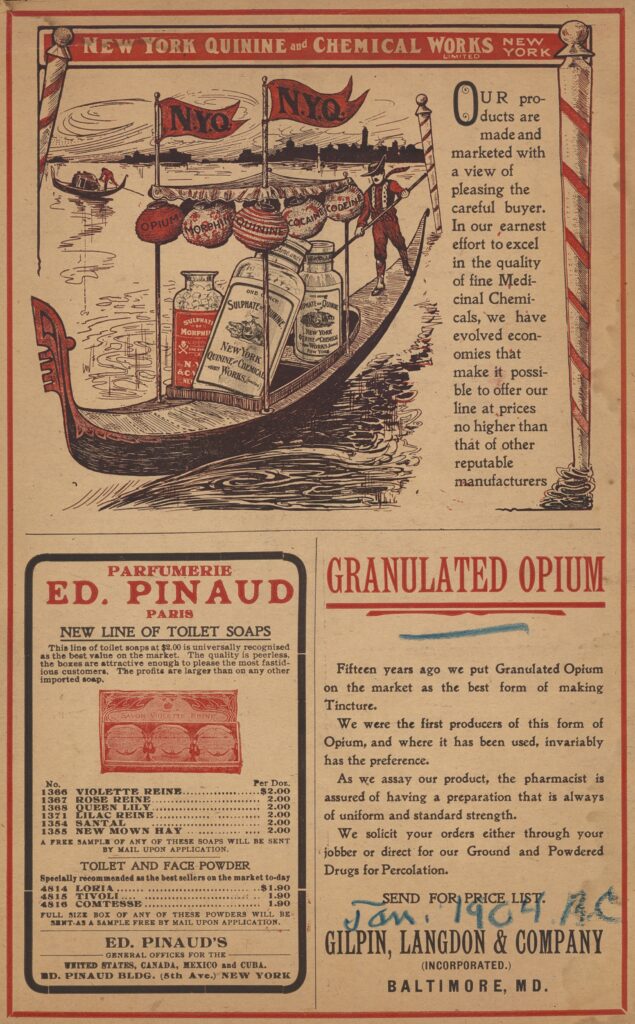
As opium use grew among the general populace, many pharmacists pointed out that the use of the drug seemed to cross economic and social boundaries. One article of The Western Druggist published in 1896 colorfully describes the vast array of opium users:
“Stand by me, if you will, by some apothecary’s window after the common laboring day is over, and see the pitiable procession of ‘fiends’ who file in and out, goaded by this arch-demon (morphine); mere boys, young men, middle-aged and white haired, staid school teachers and lovely young women, the liveried footman acting for his lady, the beggar on the streets, and the old hag–what strangely varied classes pay tribute here!”
Despite reports such as this, opium use remained associated especially with women and the working class. The same article later quotes Dr. Joseph Price, who claims “we have an army of women in America dying from the opium habit–larger than our standing army.” James M. Anders and John H. Musser, authors of the textbook Practice of Medicine, wrote in 1919 that “women are more commonly the victims of morphinism than men,” albeit with the exclusion of pharmacists and physicians who would be exposed to the drug more frequently. They go on to state that medical elixirs containing opium “are drunk to a frightful extent in large cities among the poor and miserable, and cause great disturbance of the health of the habitués.”
Though opium use and drug addiction in general would continue to be tied up with certain social categories, The Opium Problem is a significant example of a new perspective on opium use which was forming in the early twentieth century. Terry and Pellens refuted the broad, anecdotal associations of opium use with certain social categories, writing “it would appear from the data submitted that this condition [of opium use] is not restricted to any social, economic, mental, or other group,” standing in stark contrast to earlier accounts. They would also argue against a moral interpretation of drug addiction in favor of a scientific one, advocating for the establishment of a systematic research program to further the medical community’s understanding of opium use. Unfortunately, these suggestions largely went unheeded. In fact, the passage of the Harrison Act in 1914 prohibited the administration of opiates in a clinical setting except in very specific circumstances, resulting in the shuttering of much of the country’s treatment infrastructure in the 1920s and 1930s.
Despite developments toward a scientific understanding of drug addiction, moralistic interpretations of the issue remained very influential, and there was no single systematized way to handle the problem of drug addiction. The early twentieth century would see a considerable amount of federal legislation meant to restrict drug use, and often this legislation was motivated by both moral panic about drug use and the idea that the government could use scientific knowledge to better society. The next part of this series will examine the origins, characteristics, and outcomes of early examples of opium prohibition.
This Dose of History is brought to you by AIHP Intern Leo Ryan.
Bibliography
Secondary sources:
Berglund, Barbara. “Chinatown’s Tourist Terrain: Representation and Racialization in Nineteenth-Century San Francisco.” American Studies 46 no. 2 (2005): 5-36. https://www.jstor.org/stable/40643847.
Campbell, Nancy D. “Framing the ‘Opium Problem’: Protoscientific Concepts of Addiction.” in Discovering Addiction: The Science and Politics of Substance Abuse Research. University of Michigan Press, 2007: 12-28. https://www.jstor.org/stable/j.ctvnjbdtz.7.
Courtwright, David T. Dark Paradise: A History of Opium Addiction in America. Harvard University Press, 2001. Originally published in 1982. Accessed through the AIHP’s book collection.
Lee, Anthony W. “In the Opium Den.” PMLA 125, no. 1 (2010): https://www.jstor.org/stable/25614446.
Mason, Harry B. “On the Selling of Morphine to Fiends.” The Western Druggist, February, 1895: 45. Accessed through the AIHP’s Edward Kremers reference files.
Starks, Michael. “Beginnings: Opium in Silent Film.” in Cocaine Fiends and Reefer Madness: An Illustrated History of Drugs in the Movies, 1894-1978. Ronin Publishing, 1982: 13-20. Accessed through the AIHP’s book collection.
Primary sources obtained through the AIHP’s archives:
Terry, Charles and Pellens, Mildred. The Opium Problem. Patterson Smith, 1928. Reprinted 1970. The Opium Problem is the source of quotations from Alfred Stillé (95), James M. Anders, and John H. Musser (122-123).
“Opium Smuggling.” The Pharmaceutical Era, December 18, 1890: 19.
“Opium Smoking by the Chinese in Philadelphia.” The Pharmaceutical Record, November 26, 1891: 360.
“Opium Smoking.” The Druggist, c. 1880: 269. Magazine cutout, exact date of publication unknown. “The Opium Habit in Michigan.” New Remedies, April, 1879: 100.